
Your needs, this model
Does it fit your priorities?
Can the 60-by-60 L work in a corner if I need the return on a particular side?
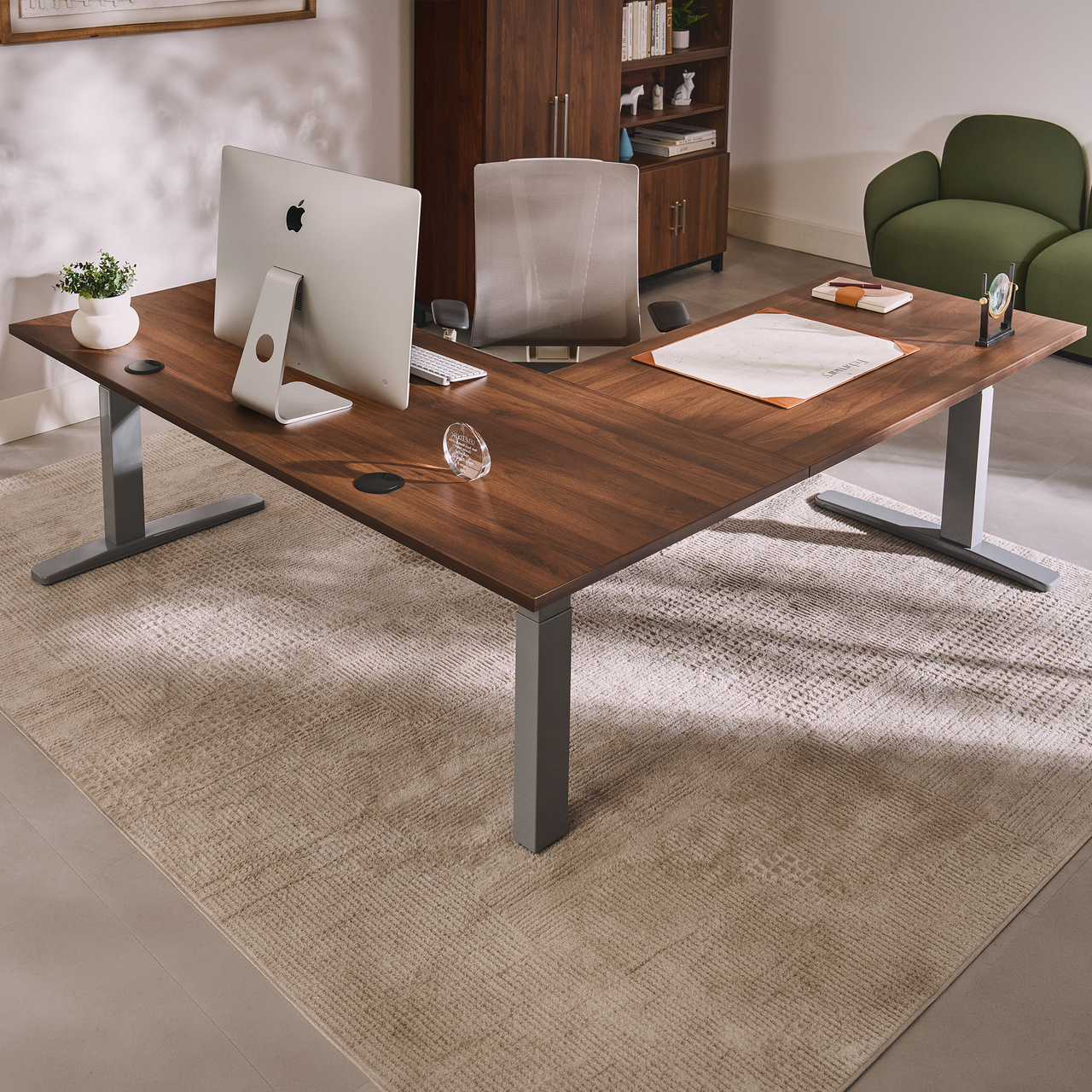
The selected UPL934 plan uses two 60-inch desktop wings with a 30-inch main depth and 27.5-inch return depth. Its non-custom top can be assembled with the return on the left or the right; custom tops are made for a selected side.
Explore this need in the finder →Can the work surface get to about 24 inches, and does the frame use three motors?
The FV3-300 frame range is 21.6–47.7 inches bare, and the selected one-inch top makes the nominal surface range about 22.6–48.7 inches. The specification and manual identify a three-motor frame. These are manufacturer specifications rather than independent measurements.
Explore this need in the finder →Can I require a confirmed 355-pound static-load rating from the manufacturer?
No. The product page/specification sheet state a 535-pound lifting capacity while the exact manual states a 355-pound weight limit; neither resolves the exact static rating or remaining equipment payload, so load matching stays unknown.
Explore this need in the finder →This assessment covers one selectable UPLIFT configuration, not every item in the L-shaped product builder: the UPL934 desk with the V3 gray three-leg frame (FV3-300), a 60-inch main and 60-inch return, Walnut Laminate 1-inch desktops, the right-return assembly, Basic Display Angled keypad, and two black grommet covers. The selected desktop is included. Other sizes, bamboo tops, V2 frame, other V3 colors, keypads and powered-grommet packages remain different choices rather than assumed contents.
A real corner work zone, not a 60-inch square top
The selector’s 60 × 60 means a 60-inch main run and 60-inch return; the official drawing labels a 60-by-60 outside L envelope with an open center. The main top is 30 inches deep, the return 27.5 inches. Walnut Laminate is a one-inch manufactured surface, not solid walnut. The two wings can separate a screen-and-keyboard area from papers or a second device, but they do not create one uninterrupted 60-by-30-inch writing surface across the corner.
This plan uses a right return. The FV3-300 manual shows that the non-custom desktop is reversible; decide left or right from the seated position before attaching the frame. It suggests putting the return on the dominant-hand side, but leaves the choice to the user. A custom top is made for the side selected at order, so the same reversibility should not be assumed.
Three motors lift the joined L together
Three lifting legs and three motors distinguish this from a two-leg desk, but they do not make two independent workstations. The FV3-300 manual shows one control box, one keypad and ports M1–M3; the joined main and return sections move together. If one wing must stay still while the other rises, choose a genuinely separate workstation.
UPLIFT gives a 21.6-to-47.7-inch bare-frame range. Add the selected one-inch top for a nominal 22.6-to-48.7-inch work surface; casters or other hardware change that. These are maker figures, not a measurement of your assembled desk. Test the range against your seated elbow height and standing setup. The sheet’s 41.3-to-72.2-inch frame-width adjustment is not the selected 60-by-60 outside L envelope. Measure both wall runs, chair path and a one-inch clearance at moving edges.
Choose controls and cable parts as a package
This plan selects the Basic Display Angled keypad. UPLIFT lists advanced keypads separately; the FV3-300 booklet's saved-height programming section is explicitly for advanced keypads. I therefore do not count a particular number of memory positions or advanced settings for this selected Basic control. If a stored sitting-and-standing button is essential, choose and assess the appropriate advanced-keypad configuration rather than assuming it comes with the basic one.
FlexMount cable-management parts are included, but they are not a closed tray. The selected two black grommet covers provide wire pass-through, not outlets or USB. The manual lists brackets, cable mounts and hook-and-loop strips, then warns an L top may lack pre-drilled bracket holes. Plan cable routing before raising the joined desk; keep slack in all three motor leads and cords. UPLIFT claims a two-inch-per-second travel speed and less than 48 dB; these were not independently measured.
Assembly is a two-surface job
The 16-page FV3-300 manual shows three legs, two desktop sections, crossbars, a corner assembly and support brackets. The return side changes the mounting-hole pattern. Two-person assembly is flagged on the cover, and the manual recommends help to flip and position the connected L; arrange a large, protected work area rather than attempting to rotate it alone. Before use, reset the desk, connect it to a grounded outlet, clear the travel path and maintain a one-inch gap. The motor duty limit is two continuous minutes followed by at least 18 minutes of rest in a 20-minute period.
Resolve the load question before a heavy setup
The product page and spec sheet give a 535-pound lifting-capacity figure; the exact FV3-300 manual instead says not to exceed a 355-pound weight limit. The maker does not reconcile them or say whether either is a static rating, how top mass counts, or what equipment payload remains. Load fields stay unknown, so a hard static-rating requirement rejects this plan. Ask UPLIFT to clarify the exact frame and top before relying on either figure. No independent stability, endurance or collision test is claimed.
Who should compare this exact plan?
Consider it if a 60-by-60 corner outline fits, three motors and one connected L surface are useful, and a 22.6-inch nominal start helps. A 59-inch wall run, a 30-inch-deep return, confirmed Basic-keypad memory, or an unresolved load threshold is a reason to look elsewhere. Compare the Vari 60x60 L-shape if four saved positions and a 25-to-50.5-inch surface range matter more than a lower start; a rectangular desk is better for one continuous top. Similar size labels do not make these the same product.
This is a document-based assessment, not a hands-on review. Manufacturer references: UPLIFT L-Shaped Standing Desk, 3-Leg (UPL934), FV3-300 instructions and the FV3-300 specification sheet.
Key details at a glance
| Minimum frame height without desktop | 21.6 in |
|---|---|
| Maximum frame height without desktop | 47.7 in |
| Leg count | 3 |
| Motor count | 3 |
| Narrowest frame width | 41.3 in |
| Widest frame width | 72.2 in |
| Cable tray included | No |
| Magnetic fabric cable cover included | No |
| Frame layout | L-shaped |
| Minimum working-surface height with desktop | 22.6 in |
| Maximum working-surface height with desktop | 48.7 in |
| Built-in AC/USB power panel | No |
| Outside L footprint width | 60 in |
| Outside L footprint depth | 60 in |
| Documented desktop material | laminate |
Use the exact model’s instructions for operating limits, supplied equipment and version differences.
Paper, software and setup details
Desktop and configuration note
Selected stock configuration includes two 1-inch Walnut Laminate desktop sections: the UPLIFT UPL934 option is 60 inches main × 60 inches return. Manufacturer lookbook dimensions show a 30-inch main depth and 27.5-inch return depth. The outer L envelope is not a solid 60 × 60 surface; the center is open. This is a laminate surface, not a solid walnut slab.
Sources for this assessment
Choose a desk around your real setup.
Start with whether you need a complete desk or a converter for an existing fixed desk, then choose the support layout and surface package. Add exact height, top and cable constraints only when they matter.