
Your needs, this model
Does it fit your priorities?
Do you already have a fixed-height desk and require a converter rather than a full desk?
The UDA115-A is a powered converter that rests on a separate host desk; the unit itself weighs 92 lb before equipment. It does not provide a floor-standing desk frame.
Explore this need in the finder →Is a Bamboo-labeled surface essential?
The selected UPLIFT selector state labels its top Bamboo. That is a material-option label, not a verified solid-bamboo construction or species claim.
Explore this need in the finder →Must the keyboard tray sit below the existing desk surface when lowered?
The UDA115 manual says its tray is below the host surface at the lowest position and warns that it must clear the host desk edge.
Explore this need in the finder →Will the 30-inch upper surface fit the required work area?
The UDA115-A specification drawing gives a 30 by 21.5-inch main surface; measure it against the items that need to travel with the converter.
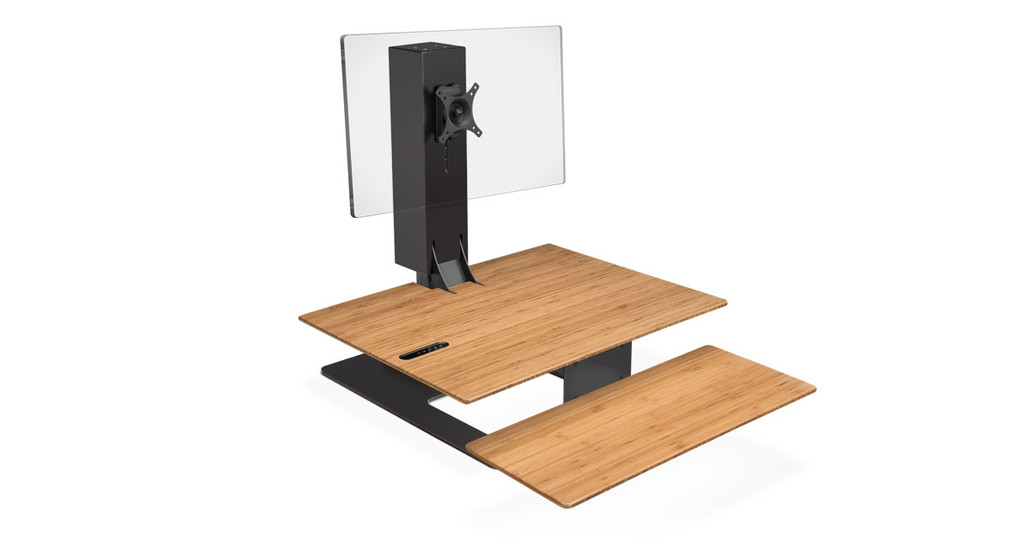
Explore this need in the finder →The UPLIFT E7 Electric Standing Desk Converter (UDA115-A) is a powered workstation that rests on another desk, not a freestanding height-adjustable desk. This review covers one selector plan: Bamboo surface (4269), black base (4266), and Single Monitor Mount Black (5813). Those selections identify what is being assessed; a product-page option state does not establish an assembled SKU, stock status, or completed sale.
Buy it only if the host desk is part of the plan
The E7 addresses a specific constraint: you want powered height changes but intend to keep a fixed-height desk. The UDA115-A base sits on top of that host surface. It does not replace the host desk, add a floor-standing frame or roll beneath a bed. The assembly instructions direct the installer to place the base on the desk with its front aligned to the desk’s front edge. The converter weighs 92 pounds before you add equipment, so first decide whether the existing desktop and supports can safely carry that mass plus your monitor and work items. A weak, bowed, narrow or poorly supported host is a reason to choose a complete desk instead, not to hope the converter will compensate.
The manufacturer gives 21 inches of adjustment travel. That describes how far the converter moves relative to its base; it is not the floor-to-work-surface range. Your existing desk establishes the lower reference height. Measure the host desk, converter and intended standing position together if an absolute height is essential. The published travel alone cannot say whether a particular person will reach a comfortable sitting or standing position.
What Bamboo means—and what the listing does not say
UPLIFT labels the selected surface “Bamboo,” and its current selector offers it separately from Natural Rubberwood and two Eco-labeled finishes. Choose this plan when the manufacturer’s Bamboo surface option is the requirement. Do not read the label as a verified construction specification: the pages reviewed do not identify a bamboo species, core, surface-layer thickness, finish recipe or solid-bamboo build. Nor do they establish comparative scratch resistance, repairability or environmental performance. If any of those details are essential, obtain the exact product documentation before buying rather than inferring them from a name or a product illustration.
The Bamboo and Natural Rubberwood versions share the UDA115-A converter mechanism in the manufacturer’s current selector, but the material labels are distinct. The Bamboo selector state is assessed here separately so that a required Bamboo match does not silently resolve to the Rubberwood-only plan. Compare the Natural Rubberwood E7 configuration if that is the label you want instead. This evidence does not establish that one surface is stronger or better for a particular care routine.
Check the small work area and the lower tray
The manufacturer’s specification drawing gives the upper surface as 30 by 21.5 inches and the keyboard tray as 28 by 10.5 inches. That is enough to define a compact workstation, but it is not a replacement-size desktop. Measure the keyboard, pointing device, display base or other objects that need to travel on the surface; keep equipment centered and away from the edges as the manual cautions. The selected one-monitor mount has a 17.6-pound limit and VESA 75- or 100-millimeter patterns. A heavier display or a requirement for two or three independent arms needs a separately selected and assessed option, not an assumption from the product-family headline.
The lower tier is a real ergonomic distinction, but it creates a host-desk clearance test. At the lowest position the manual says the keyboard tray sits below the existing desk surface. Measure the desk’s front edge, apron, drawers and anything attached beneath it. A tray that strikes the desk as it travels will frustrate both sitting and lowering; the feature is only useful if your specific host geometry leaves a clear path.
Capacity and powered-use constraints
The UDA115 manual states a maximum unit load of 110 pounds, while the specification sheet calls 110 pounds the maximum lifting capacity. The documents do not publish a separate static rating or a remaining payload after the 92-pound converter and mounted equipment are counted. Do not treat 110 pounds as the old desk’s safe capacity or as 110 usable pounds for accessories. If your decision depends on a minimum static-load number, this plan should fail that filter because the required rating is unknown.
The unit uses a 120 V AC, 60 Hz supply with up to 200 W input. Its keypad stores two positions; the motor duty cycle is 10%, with the manual illustrating two minutes of movement followed by eighteen minutes of rest in a twenty-minute period. Leave cord slack through the full travel. The manual recommends removing equipment and using two people to move the converter by its base. Those details matter if you plan frequent transitions, have a tightly routed power cable, or expect to relocate it often.
Who should choose this exact plan?
Consider the Bamboo E7 when the fixed desk already works, the surface-size and host-clearance checks pass, electric movement is wanted, and a Bamboo-labeled surface with one light-enough monitor is the intended setup. Skip it when you need a complete independent desk, a wider traveling surface, an assured absolute height without measuring the host, a documented static load rating, or a specific bamboo construction claim the source does not make. If the host desk is the problem—or if its edge, drawers or support are uncertain—a full adjustable desk is the more honest comparison. Compare its supplied frame, desktop and exact height basis rather than treating a converter and desk as interchangeable.
Before deciding, review the UPLIFT Bamboo / black / single-mount selector state, the UDA115 instructions and the UDA115 specification sheet. Measure the host before ordering and confirm current terms with the manufacturer.
Key details at a glance
| Leg count | 1 |
|---|---|
| Motor count | 1 |
| Minimum supported desktop width | 21.5 in |
| Maximum supported desktop width | 21.5 in |
| Minimum supported desktop depth | 21.5 in |
| Maximum supported desktop depth | 21.5 in |
| Programmable height presets | 2 |
| Frame layout | desktop-converter |
| Built-in drawer included | No |
| Built-in AC/USB power panel | No |
| Built-in AC outlets | 0 |
| Documented desktop material | bamboo |
| Selected monitor mounting positions | 1 |
| ACC116 triple-mount capacity | 17.6 lb |
Use the exact model’s instructions for operating limits, supplied equipment and version differences.
Sources for this assessment
- UPLIFT E7 UDA115 selected Bamboo / black base / Single Monitor Mount Black option state
- UPLIFT E7 Electric Standing Desk Converter current manufacturer page
- UPLIFT E7 Electric Standing Desk Converter UDA115-A instructions
- UPLIFT E7 UDA115-A specification sheet
- UPLIFT E7 Bamboo surface / black base / single mount manufacturer product render
- UPLIFT Price Book + Specification Guide, page 63 (2022/2023 edition)

Choose a desk around your real setup.
Start with whether you need a complete desk or a converter for an existing fixed desk, then choose the support layout and surface package. Add exact height, top and cable constraints only when they matter.