
Your needs, this model
Does it fit your priorities?
Which support layout does your room require?
These exact configurations use a four-leg rectangular frame. Leg count describes the design; it is not a comparative stability test.
Explore this need in the finder →What minimum tabletop length must the included desk provide?
The selected complete desk has a 48-inch or 59-inch nominal long side; 60 inches is not one of the reviewed sizes.
Explore this need in the finder →What minimum work-surface depth do you need?
Both reviewed configurations have a 27-inch-deep top. A deeper requirement does not fit either exact plan.
Explore this need in the finder →What is the highest acceptable minimum work-surface height?
The product sheet gives a 27.3-inch minimum finished top. Use that surface figure rather than a bare-frame endpoint.
Explore this need in the finder →What published static-load rating must be stated?
Branch publishes a separate 450 lb static-load rating as well as up to 225 lb of lift capacity; the static figure is not the lift rating.
Explore this need in the finder →Can an exact Branch Four Leg finish match a long-side requirement?
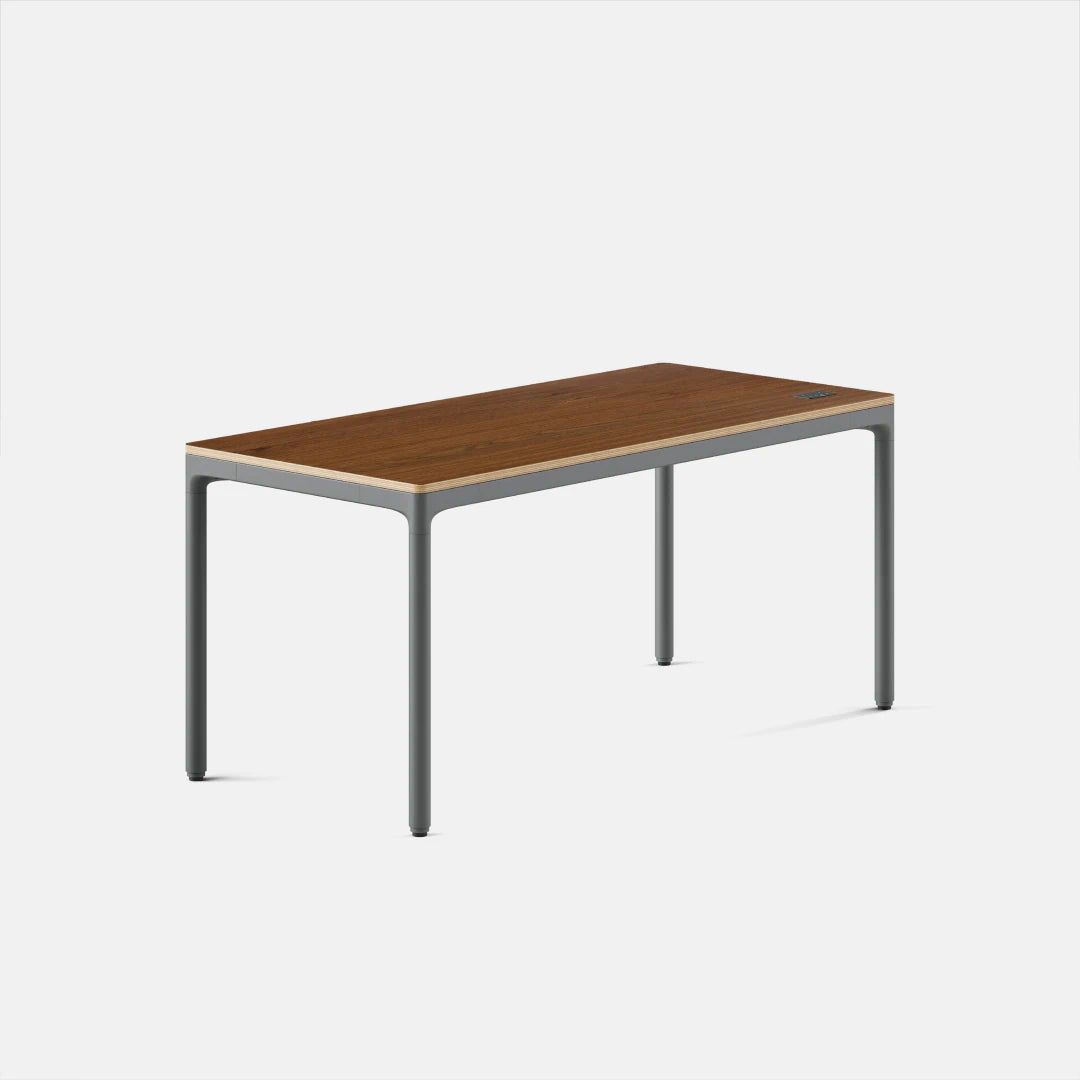
The current U.S. feed offers Cognac Oak / Carbon at 48 × 27 (SKU 10-09-05-100) and 59 × 27 (SKU 10-09-06-100). The exact finish and size must coexist in one plan; a 60-inch minimum does not fit either plan.
Explore this need in the finder →Branch’s Four Leg Standing Desk pairs a traditional four-post outline with four hidden motors. This review covers eight U.S. selector configurations: four top/leg finishes in 48 × 27 and 59 × 27 inches. Finish, SKU and image vary; lift figures come from shared documentation. Stock can change.
Choose a top and leg finish as well as the size
The official feed lists Bleached Oak / White (10-09-05-101, 10-09-06-101), Bleached Oak / Carbon (10-09-05-102, 10-09-06-102), Cognac Oak / White (10-09-05-99, 10-09-06-99), and Cognac Oak / Carbon (10-09-05-100, 10-09-06-100). In each pair, the first SKU is 48 × 27 inches and the second 59 × 27. Verify the selected SKU; finish alone does not establish top construction.
I inspected each linked manufacturer image: they distinguish the two oak tones, White or Carbon legs, and both widths. Branch does not say whether these isolated product views are photographs or renderings. Screen color is not a finish standard; images cannot verify board core or optional cable hardware. If color is critical, ask about a physical sample.
Choose between the two footprints
Both tops are 27 inches deep. The 48 × 27 takes less room; 59 × 27 adds nearly a foot for a broader keyboard, monitor base or papers, but uses more floor and wall space. Tape out the top and account for chair travel, doors, drawers and cables. Specs list nominal dimensions, not your equipment’s fit.
The two plans share the same published 27.3-to-44.6-inch completed-surface range, four-motor lift, three memory presets and 10-year stated warranty. There is no higher-end performance tier attached to the 59-inch option in the materials reviewed; its documented difference here is the wider work surface. Neither is an L-shaped return or an extendable top.
Check the range against your working positions
The lowest completed surface is 27.3 inches above the floor and the highest is 44.6 inches, a 17.3-inch change. Those endpoints can be useful if they suit the person’s seated and standing elbow positions, but the desk’s name or number of legs cannot tell you whether your particular chair, body and keyboard setup will fit. Measure from the floor to your actual work surface and check the monitor position at both ends. If you require a minimum below 27.3 inches or an upper setting above 44.6 inches, this is not the model to assume will meet that requirement.
Branch publishes a 1.25-inch-per-second operating speed and noise below 53 dB. These are manufacturer figures, not measurements from a comparative test here; the page gives no measurement method or load condition. Branch also advertises lift capacity up to 225 pounds and a 450-pound static-load capacity. Keep those statements distinct: the 450-pound figure is not the desk’s lifting rating, and the documents reviewed do not explain precisely how desktop mass and attachments count against the moving payload. Do not use either number to guess an undocumented equipment allowance.
Controls and what the base package includes
The current product page lists an LED control paddle with three saved positions and collision detection. The linked user guide explains how to save up to three heights, lock and unlock the handset, and program minimum and maximum travel limits. Those are useful everyday controls when you regularly switch between specific settings or need a user-set stop. They are not evidence of tested collision performance or a safety certification, and the height lock should not be treated as a child-proofing device.
Do not assume the optional Cable Organizer or power-strip version comes with the desk. Branch lists it separately; the assembly guide includes cable clips and requires slack through full travel. Although the page calls the setup built-in cord management, the pictured organizer is an add-on. If containment or outlets are essential, confirm the exact bundle before ordering.
Materials, assembly and care deserve a close look
There is a real documentation ambiguity about the top construction. The current product page describes a plywood top or a melamine-and-MDF top, and its page copy also calls the surface premium melamine; the linked product spec sheet instead says plywood and HPL. Neither source clearly maps those general descriptions to the newly named Bleached Oak selector, so this review leaves its exact board-and-surface construction unconfirmed. The color name alone does not establish solid wood, veneer or a specific laminate.
The 26-page assembly and user guide requires two people. It says not to alter the desk or electrical parts, keep components dry and children away from moving legs and cords, and never sit or stand on the desk. Use cords long enough for full travel and follow the guide’s leveling and routing steps. Branch lists a 10-year warranty; check current coverage and exclusions.
Who should compare it with Duo or Tria?
Choose Four Leg if its traditional outline, 48- or 59-inch rectangular top and stated height endpoints fit your room and measurements. It is not proven more stable than two-leg desks; no comparative stability test is claimed. Duo is a simpler two-leg alternative with a published 28-to-47.3-inch range and 36 × 24, 48 × 24 or 58 × 27 tops. Tria reaches a lower 25.5-inch minimum and higher 48.9-inch maximum in the reviewed configurations, with its own Bluetooth and cable features. Compare dimensions and range before paying for a frame silhouette.
For the exact surface choices and the tradeoffs between those three Branch frames, see the Branch Four Leg, Duo and Tria comparison guide. This review is based on manufacturer pages, a variant feed, a spec sheet and the assembly guide; it does not claim personal ownership, measured motor performance, an independent load test, or a verified price or inventory guarantee.
Key details at a glance
| Published maximum static-load rating | 450 lb |
|---|---|
| Published maximum lifting-load rating | 225 lb |
| Leg count | 4 |
| Motor count | 4 |
| Minimum supported desktop width | 48 in |
| Maximum supported desktop width | 59 in |
| Minimum supported desktop depth | 27 in |
| Maximum supported desktop depth | 27 in |
| Programmable height presets | 3 |
| Published frame and mechanism warranty | 10 years |
| Frame layout | four-leg rectangular |
| Minimum working-surface height with desktop | 27.3 in |
| Maximum working-surface height with desktop | 44.6 in |
| Built-in drawer included | No |
| Built-in AC/USB power panel | No |
| Built-in AC outlets | 0 |
Use the exact model’s instructions for operating limits, supplied equipment and version differences.
Sources for this assessment
- Branch Four Leg Standing Desk U.S. product page
- Branch Four Leg Standing Desk official Shopify selector feed
- Branch Four Leg Standing Desk Product Spec Sheet
- Branch U.S. assembly guides index
- Branch Four Leg Standing Desk Assembly and User Guide (2024-08-22)
- Branch exact-variant image: 48 inches x 27 inches Bleached Oak / White
- Branch exact-variant image: 59 inches x 27 inches Bleached Oak / White
- Branch exact selector image: 48 inches x 27 inches Bleached Oak / Carbon
- Branch exact selector image: 59 inches x 27 inches Bleached Oak / Carbon
- Branch exact selector image: 48 inches x 27 inches Cognac Oak / White
- Branch exact selector image: 59 inches x 27 inches Cognac Oak / White
- Branch exact selector image: 48 inches x 27 inches Cognac Oak / Carbon
- Branch exact selector image: 59 inches x 27 inches Cognac Oak / Carbon


Choose a desk around your real setup.
Start with whether you need a complete desk or a converter for an existing fixed desk, then choose the support layout and surface package. Add exact height, top and cable constraints only when they matter.