
Your needs, this model
Does it fit your priorities?
Does the 120-degree wraparound desk profile suit your workspace better than a straight or center-cutout top?
This selected UPL120 plan is a two-leg desk with an angled-back, curved-front 120-degree outline; it is not the conventional straight-front top or the separate curved-corner center-cutout state.
Explore this need in the finder →Can your room provide at least 38.4 inches of depth for the UPL120 outside footprint?
The official drawing measures a 38.4-inch outside-depth envelope. This is a room-fit dimension, not a uniform working depth.
Explore this need in the finder →Do you require a top at least 71 inches across its widest dimension?
The UPL120 drawing gives 71.7 inches overall width, so a 71-inch minimum fits while a 72-inch minimum does not.
Explore this need in the finder →Do you need a covered cable opening rather than a powered grommet, and is a no-hole top essential?
This state selects two black grommet covers. They cover cable openings but do not add power; the top is not uncut.
Explore this need in the finder →Can a 38.4-inch outside footprint satisfy a room limit without assuming the whole top has a uniform 30-inch usable depth?
A 39-inch room-depth limit fits the outside envelope. The drawing does not establish a uniform minimum usable depth, so adding a hard 30-inch minimum-depth requirement must reject the plan.
Explore this need in the finder →This assessment covers one selected U.S. configuration of the UPLIFT V3 120-Degree Standing Desk: model UPL120, a Walnut Laminate 1-inch top, black V3 C-frame with 27-inch feet, two black grommet covers and the Basic Display Angled keypad. The product page lists other top materials, frame finishes, controls and accessories. This is not a claim that every combination is available, in stock or part of a finished order.
Measure the outline, not a rectangle
The reason to look at UPL120 is its unusual top, not a new kind of motor. The UPLIFT dimension sheet gives a maximum outside footprint of 71.7 inches wide by 38.4 inches deep, with a broad curved front and several angled rear edges. Those numbers describe the outer envelope; they do not mean that the entire top is 38.4 inches deep. The drawing’s curved front span is 47.6 inches, and it also shows a 26-inch upper interior span and 10.4-inch center span. No uniform minimum work-depth is published. If your keyboard, tablet or equipment must sit on a reliably deep rectangular surface, do not treat the maximum depth as proof of a 30-inch usable zone. Tape out the whole contour and check monitors, walls, doors and nearby chairs before choosing it.
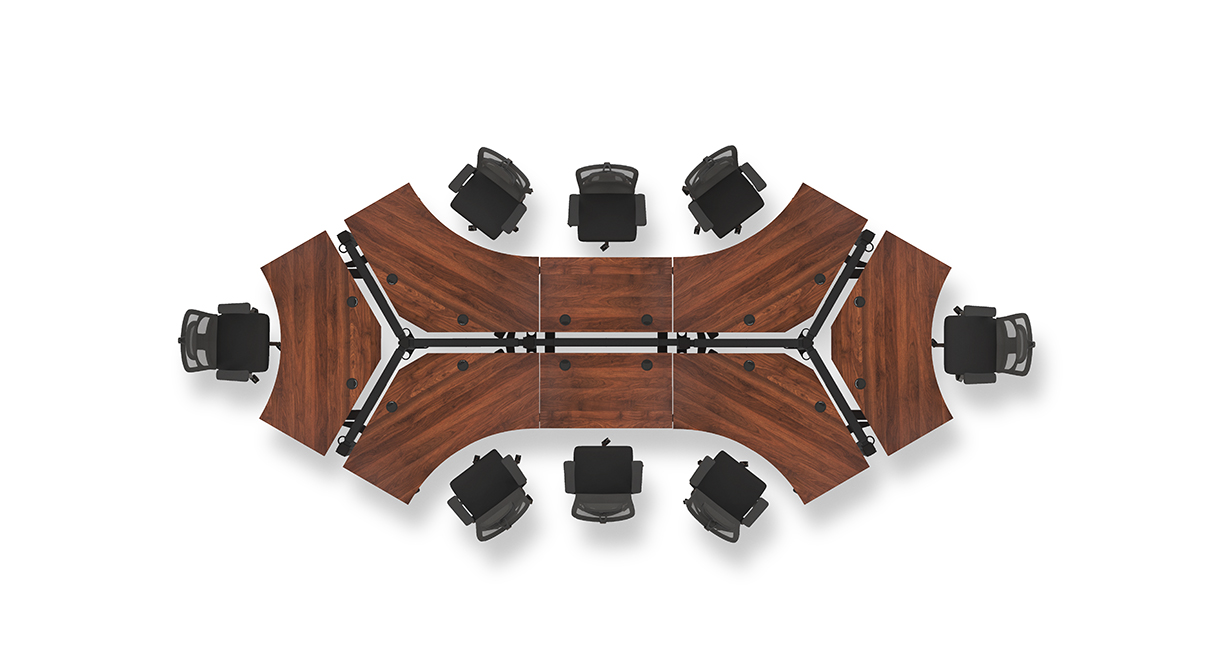
The silhouette can make sense for a command-style setup that spreads controls or screens along more than one edge. UPLIFT shows pod and dog-bone arrangements for teams, but those are examples rather than an office-layout plan; they do not establish aisle clearance or the result when users raise neighboring desks. A single UPL120 is still a two-leg desk. If you want a conventional pair of perpendicular work surfaces and a separate corner return, compare a three-leg L-shaped desk instead. If predictable front-to-back dimensions matter more than the wraparound outline, a standard rectangular V3 is a simpler fit.
One important surface-specification mismatch
The selected current page option is named Walnut Laminate 1 inch, so this review classifies the selected surface as laminate, not solid walnut. However, the official UPL120 top-specification PDF lists Carbonized Bamboo and black or white low-pressure laminate and does not list Walnut. That is an unresolved difference between the live selector and the model-specific specification sheet. Confirm that the Walnut option belongs to the exact UPL120 surface you intend to order; do not infer that it is solid wood or assume the older spec list covers every live option. The top sheet gives no weight for the selected finish, another reason not to turn a frame lifting figure into an equipment payload.
The selected layout includes two 3.15-inch holes with black covers. They give you a covered route for cables, not desktop outlets or USB charging. The product page describes a FlexMount cable manager and ten cable wraps as included with V3 desks. That is useful slack-management hardware, but it is not a closed metal tray. The Basic Display Angled keypad is a continuous-touch control: the V3 page distinguishes it from advanced one-touch keypads. The manual’s saved-height programming instructions specifically exclude the Basic Display keypad, so memory presets are not credited here.
Range, load and setup limits
For this one-inch-top plan, UPLIFT publishes a 22.6–48.7-inch desk-height range; the C-frame sheet separately gives 21.6–47.7 inches for the frame without a top. Compare the finished-surface range with your seated and standing elbow positions, not only the bare-frame figure. The frame width is adjustable from 41.3 to 72.2 inches, while the top itself spans 71.7 inches at its widest. Check where the legs and feet will land under the irregular surface rather than assuming the frame’s widest setting determines the whole desk footprint.
The current page advertises 355 pounds of lift capacity; the C-frame manual also gives a 355-pound weight limit. Neither source establishes a separate static-load rating or the remaining safe equipment payload after accounting for the top and accessories. The lifting number is a maker claim, not a result from our own testing. A finder request for a minimum static rating should therefore reject this plan as unknown rather than treat 355 pounds as a static rating.
The manual is specific about setup: use the C-frame instructions rather than the T-frame or frame-only version, leave at least one inch around moving parts, keep power and accessory cords slack, plug into a grounded outlet, and perform the reset before first use. It states a 10-percent motor duty cycle: after two continuous minutes of movement in a 20-minute interval, allow at least 18 minutes of rest. Leave clearance around the moving outline and keep the included cable slack free during travel.
Who should consider this exact plan?
Consider it if you want a distinctive two-leg workstation, have measured a nearly six-foot-wide by just-over-three-foot-deep outside footprint, and can use the wraparound shape without needing a guaranteed uniform depth. It is a poor match when a shallow room, a strict minimum usable desktop depth, a no-hole top, built-in power, saved keypad positions or a confirmed static-load rating is essential. In the finder, a two-leg desk with an included top and the 120-degree wraparound profile can lead here. Use the separate outside-envelope-depth question: a 38-inch room allowance does not clear the 38.4-inch outline, even though the minimum usable top depth remains unknown; a 72-inch minimum top-width requirement also exceeds the 71.7-inch drawing. Requiring a straight front, solid wood or a documented 30-inch minimum depth should change the result. Compare UPL120 with a rectangular V3 for a conventional top or a three-leg L-shaped model for a true return, then verify the selected materials and accessories on the live order page.
This is a source-based assessment, not a hands-on test. The archived UPLIFT overhead dog-bone image visibly shows several 120-degree desk outlines and the maker alt identifies that arrangement. It is not a close-up of this selected black-frame plan, so it cannot verify the keypad or covered grommets; UPLIFT does not state whether the image is a photograph or rendering.
Key details at a glance
| Minimum frame height without desktop | 21.6 in |
|---|---|
| Maximum frame height without desktop | 47.7 in |
| Leg count | 2 |
| Motor count | 2 |
| Narrowest frame width | 41.3 in |
| Widest frame width | 72.2 in |
| Minimum supported desktop width | 71.7 in |
| Maximum supported desktop width | 71.7 in |
| Maximum supported desktop depth | 38.4 in |
| Cable tray included | No |
| Magnetic fabric cable cover included | No |
| Frame layout | 120-degree-wraparound |
| Minimum working-surface height with desktop | 22.6 in |
| Maximum working-surface height with desktop | 48.7 in |
| Wireless charging built into desktop | No |
| Built-in AC/USB power panel | No |
| Built-in AC outlets | 0 |
| Documented desktop material | laminate |
Use the exact model’s instructions for operating limits, supplied equipment and version differences.
Paper, software and setup details
Desktop and configuration note
The UPL120 diagram gives a 71.7-inch overall width and 38.4-inch outside-depth envelope, with angled edges and a curved front. It is not a uniform rectangle; no minimum usable depth is established. The current page selector calls the selected top Walnut Laminate 1 inch, while the UPL120 model-spec PDF lists only carbonized bamboo and black/white low-pressure laminate. Verify the finish with the seller.
Load-rating interpretation
355-pound lifting/weight-limit wording is not converted to a static-load rating or payload after the desktop/accessories.
Operating and setup note
Manual requires grounded power, slack cords, 1-inch clearance around moving parts, reset before initial use and an 18-minute rest after two continuous minutes of motor activity in a 20-minute period.
Sources for this assessment
- UPLIFT V3 120-Degree Standing Desk UPL120, selected Walnut/C-frame state
- UPLIFT 120-Degree Desktop UPL120, SP-UPL120-1.2
- UPLIFT V3 Standing Desk FV3-200 C-Frame Instructions, 16 pages
- UPLIFT V3 FV3-200 C-frame specification sheet (previously archived exact primary source)
- UPLIFT page-linked Walnut/Industrial gallery candidate (rejected for review card after visual audit)
- UPLIFT maker image of a dog-bone arrangement of 120-Degree Standing Desks


Choose a desk around your real setup.
Start with whether you need a complete desk or a converter for an existing fixed desk, then choose the support layout and surface package. Add exact height, top and cable constraints only when they matter.