
Your needs, this model
Does it fit your priorities?
Do you need a 72-inch desktop in the same configuration as the included MVT011?
This exact selector plan has a fixed 72 × 30-inch desktop. It does not fit a shorter or deeper-than-30-inch requirement as the same plan.
Explore this need in the finder →Do you require a solid-wood desktop?
No. The selected Walnut surface is a 1-inch laminate, not solid wood; a solid-wood requirement should exclude it.
Explore this need in the finder →Will the selected pad fit with the manufacturer’s minimum floor clearance?
The MVT011 manual requires at least 36 inches behind the pad and 12 inches on each side. Both are essential room checks for this bundled plan.
Explore this need in the finder →Is a maximum pad speed of 4 mph and incline of 7% enough?
The MVT011 specification gives a 4 mph speed ceiling and 7% maximum incline. A higher minimum requirement is not met by this configuration.
Explore this need in the finder →Do you need four lifting legs instead of this two-leg frame?
The selected V3 C-frame has two lifting columns. It cannot satisfy an essential four-leg support requirement.
Explore this need in the finder →This review covers one UPLIFT Treadmill Desk selector plan: the UPL964 listing with a 72 × 30-inch Walnut Laminate desktop, black V3 C-frame with the 27.5-inch-foot option, black FRM072 Basic Display Angled Keypad, no grommet holes, and the included MVT011 Inclining Walking Pad. The listing contains other surface sizes and styles, but they are not interchangeable with this assessment. Use the current product selector to make sure the desk and pad choices you want appear together; a search result for the base model alone does not specify this entire setup.
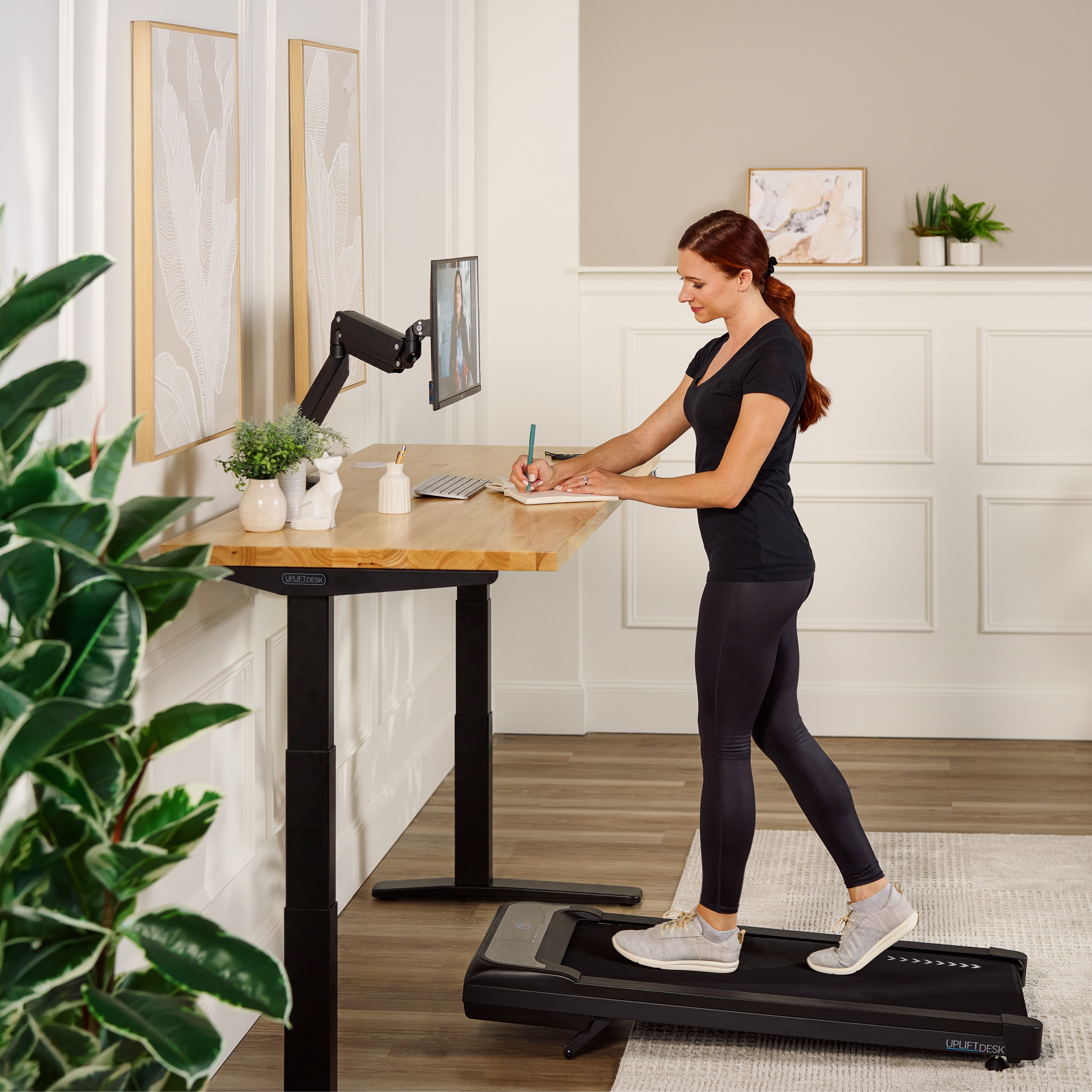
More worktop length, not a wider walking belt
The chosen top is 72 inches long and 30 inches deep. That adds two feet of length over the separately reviewed 48 × 30-inch Treadmill Desk option while keeping the same 30-inch depth. By area, 72 × 30 is 15 square feet compared with 10 square feet for 48 × 30—a 50 percent increase in work surface. That is useful if your equipment arrangement really needs a long continuous span, but it also makes the desk harder to place in a compact room. A long top remains one shared work height; it is not evidence of two independently adjustable stations.
Walnut here is a 1-inch laminate selector option, not a solid-wood desktop. If natural solid wood is essential, this plan should fail that requirement even though its surface has a wood appearance. The selected top has no desktop grommet holes. Plan how power and data reach devices before assembly, using the frame cable manager and a safe route that will not rub on the lifting legs or walking belt. Do not count optional accessories from a different checkout selection as included.
The pad still governs the floor plan
UPLIFT identifies the included MVT011 as an Inclining Walking Pad, a separate low-profile device rather than a treadmill console integrated into the desk. Its specification lists a 48 × 20.25-inch footprint, a 39.4 × 15.4-inch belt, a 0.75-horsepower motor, ten incline levels to 7 percent, and a speed range of 0.6 to 4 mph. A 72-inch tabletop does not enlarge that belt or raise its 4 mph ceiling.
The MVT011 manual requires at least 36 inches of unobstructed floor behind the pad and 12 inches on each side. Measure those clearances around the machine itself, not merely around the desktop. A wall or cabinet may fit behind a long desk but still leave too little space at the pad; a walkway can be pinched by the pad even when the 72-inch top appears to fit. The manufacturer instructions also call for a stable, level surface and a grounded 120V supply. They disallow adapters and extension cords for the pad, so plan a direct outlet for it separately from the powered desk frame.
Check the user's working height and load assumptions
The V3 C-frame specification gives a 21.6–47.7-inch frame range, two motors, 2 inches per second travel, and a 355-pound lifting-capacity figure. That 355-pound figure is not a confirmed static-load rating or the usable payload after the selected desktop and other equipment are considered. The desk manual calls for a first-use reset, grounded power, slack in moving cords, and keeping clear of moving parts; repeated adjustments are limited by a 10 percent motor duty cycle. These are setup and operating constraints, not promises of measured stability or noise in your room.
The walking belt sits above the floor, so the desk's frame range alone does not tell you whether the surface will land at a useful height while you stand on the pad. The combined surface height over the belt has not been established here. Measure your actual reach and test the intended placement before treating the maximum or minimum frame setting as a fit. There is also an unresolved source difference in the pad's maximum user weight: its manual says 240 pounds while the specification sheet says 243 pounds. Neither figure is used as a confirmed eligibility threshold; ask UPLIFT for written clarification if that limit matters to you.
Who should consider this exact arrangement?
This option is worth comparing if you need a long 72-inch worktop, prefer the Walnut Laminate surface, and want the MVT011 included in the same UPLIFT listing. The useful questions are concrete: can the 72 × 30-inch top fit the room, can the pad's full clearance envelope remain open, can the desk reach your working height from the raised belt, and do the pad's 4 mph and 7 percent ceilings satisfy your own requirements? A required 4.1 mph or more incline than the documented maximum should rule it out rather than be softened by the desk frame's specifications.
Choose a shorter 48 × 30-inch option if two extra feet of desk length would crowd the room; choose an ordinary V3 desk without the pad if you do not need a moving belt or cannot provide the manual clearances. The separate machines also mean separate controls, cords and setup instructions. Before purchase, confirm that the live selector still shows the Walnut 72 × 30 top, the no-grommet choice, black C-frame, Basic Display keypad and MVT011 together. This review reports no personal test, ownership experience, measured noise, user reviews, health outcome, or price comparison.
Sources: UPLIFT Treadmill Desk selector, the MVT011 instructions and MVT011 specifications, and the V3 C-frame manual and frame specification.
Key details at a glance
| Minimum frame height without desktop | 21.6 in |
|---|---|
| Maximum frame height without desktop | 47.7 in |
| Leg count | 2 |
| Motor count | 2 |
| Narrowest frame width | 41.3 in |
| Widest frame width | 72.2 in |
| Minimum supported desktop width | 30 in |
| Maximum supported desktop width | 30 in |
| Frame layout | rectangular |
| Built-in AC/USB power panel | No |
| Built-in AC outlets | 0 |
| Documented desktop material | laminate |
Use the exact model’s instructions for operating limits, supplied equipment and version differences.
Paper, software and setup details
Operating and setup note
The selected UPL964 listing choices describe a 72 × 30-inch, 1-inch Walnut Laminate surface, black V3 C-frame, FRM072 Basic Display keypad, no desktop grommets and required MVT011 pad. The official product-page selector and current selector-response URL preserve option IDs, but server HTML defaults do not confirm a final cart SKU, separate retail model or combination-level stock. Keep this plan’s dimensions and bundle choices distinct from other selector variants. The desk uses grounded 100–240V power; MVT011 separately requires a grounded 120V outlet with no adapter or extension. Its 36-inch rear/12-inch side clearances, raised belt, unknown combined working-surface height, 355 lb lift-capacity basis and unresolved 240/243 lb user-weight discrepancy remain explicit.
Sources for this assessment
- UPLIFT Treadmill Desk UPL964 current U.S. product and selector page
- UPLIFT Treadmill Desk UPL964 72x30 Walnut selector URL response
- UPLIFT V3 FV3-200 C-frame instructions
- UPLIFT V3 FV3-200 C-frame specifications
- UPLIFT MVT011 Inclining Walking Pad instructions
- UPLIFT MVT011 Inclining Walking Pad specifications
Choose a desk around your real setup.
Start with whether you need a complete desk or a converter for an existing fixed desk, then choose the support layout and surface package. Add exact height, top and cable constraints only when they matter.