
Your needs, this model
Does it fit your priorities?
Which Tria top and leg-color pair do you require?
This assessment covers Black Oak top with Black legs. The exact media visually matches the finish/base; the specification sheet calls the desktop laminated MDF, not solid oak.
Explore this need in the finder →What actual long-edge length and top depth must the same included Tria desk provide?
The largest Black Oak / Black plan is 70.9 × 29.5 inches; the middle is 58 × 27 inches and the smallest is 47.2 × 27 inches.
Explore this need in the finder →What maximum minimum finished desktop height fits your seated position?
Branch gives the completed surface a 25.5-inch lower endpoint. A requirement below that is outside the published range.
Explore this need in the finder →Is a laminated-MDF surface acceptable, or do you need solid wood?
Branch identifies the Tria top as laminated MDF; Black Oak is a finish name and does not meet a solid-wood requirement.
Explore this need in the finder →The Branch Tria in Black Oak with Black legs is the darker finish of Branch’s three-stage electric standing desk. Its appeal is straightforward: the top and frame make a coordinated dark setup, while the desk retains the same size range, lift controls and cable-management design as other Tria finishes. The label “Black Oak” describes an appearance, not a promise of solid oak. Branch’s specification sheet lists the desktop as laminated MDF.
Choose by the published work-surface dimensions
Black Oak / Black is offered in three size selectors in the archived U.S. product feed. The nominal 48 × 27-inch option has an actual 47.2 × 27-inch top (SKU 10-14-05-75); the 58 × 27-inch option measures 58 × 27 inches (SKU 10-14-09-75); and the marketed 71 × 30-inch size is 70.9 × 29.5 inches (SKU 10-14-13-75). These are separate complete-desk selections, not a promise that every surface shown in a product image is that size.
The 48-inch version is the smallest Tria footprint in this assessment, but its actual long edge is shorter than a strict 48-inch requirement. The middle size adds width without adding depth, which can help if a larger keyboard-and-monitor area is useful but the room is shallow. The largest adds nearly another foot of width and 2.5 inches of depth over the 58-inch size; measure chair clearance, wall distance, cables and door movement before ordering. If you require a full 71-inch top or a full 30-inch depth, the spec-sheet dimensions do not quite meet either threshold.
Dark finish, laminate construction
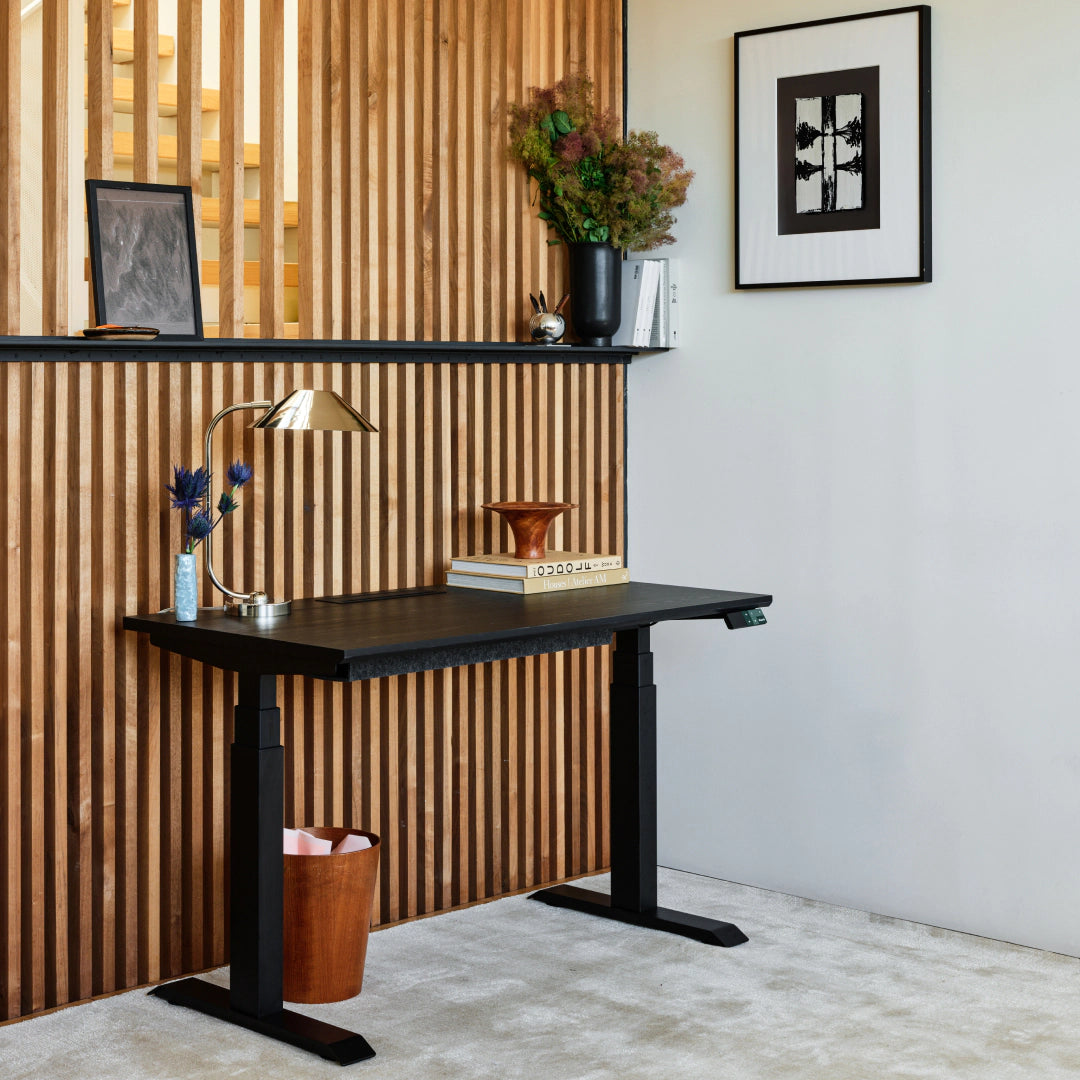
Black Oak is the manufacturer’s finish name, and the Tria specification sheet identifies its listed tops as laminated MDF. It is not evidence of a solid-oak or oak-veneer work surface. Consider the Tria when the coordinated dark appearance is the goal and a laminated surface meets your material needs. If real wood is essential, compare desks whose documentation identifies the wood construction rather than relying on a color label. The exact manufacturer media inspected for this version shows a dark top and black legs, but it does not identify a size or state whether the image is a photograph or a rendering.
The black frame is also a real part of the selector, not an incidental detail. Pick Black Oak / Black only when both the dark desktop and black legs fit the room. Natural Oak / White shares the Tria mechanism and offers a lighter top-and-frame combination; selecting that alternative changes the finish, not the published lifting range or construction claims. A finish choice should not outweigh a top that is too large for the room or a minimum height that does not fit the user.
Measure seated and standing positions
Branch gives all three Tria sizes a completed-surface range of 25.5 to 48.9 inches from the floor and describes a 23-inch lift range. The sheet does not give a separate bare-frame endpoint. The three-stage columns and broad published range make it worth checking for shared work areas, but no range automatically fits every body, chair or keyboard setup. Compare the lowest surface position with your seated posture and the upper position with your standing elbow height; include footwear and any desktop-mounted equipment in your planning.
The OLED keypad offers two saved positions, a USB-C charging port and sedentary reminders. Branch also describes collision detection and Bluetooth pairing with its Ergonomics iOS app for activity tracking and scheduled standing sessions. These are convenience features for changing positions and remembering to move; they do not make posture decisions for you. The specification sheet does not state the keypad USB-C output wattage, so do not count it as a known laptop-charging supply.
Plan cable routing and load separately
The desktop cable opening and PET felt organizer are part of the listed Tria setup. A cable tray and in-desk power are compatible add-ons, not included automatically with the Black Oak / Black desk. If a power panel matters, verify that separate module and its ports before choosing; the small charging port on the keypad is not the same as the optional desktop AC outlets. Run through the assembly guide’s cable-routing steps before settling on outlet placement, especially if the desk will move between two stored heights.
Branch states a 275-pound maximum capacity, but the specification sheet does not say whether that means a static or moving load or whether the desktop weight is included. Treat it as a manufacturer claim with an unspecified basis, not as a confirmed 275-pound payload above the desktop. That uncertainty matters more than the dark finish if you plan to keep a heavy computer, multiple displays and accessories on the surface. The sheet lists a 10-year warranty for tabletop and frame components; review the current warranty terms for exclusions and service details.
Who should compare another desk
This Tria configuration is a sensible shortlist candidate when the Black Oak / Black combination is important, one of the three actual footprints fits, and the 25.5-inch minimum finished height works. Compare a smaller desk if the 47.2 × 27-inch smallest Tria top still crowds the room. Compare a model with documented solid wood if surface construction is non-negotiable. For the same Tria controls and frame range in a different room palette, compare the Natural Oak / White or Woodgrain / White versions rather than treating finish names as different mechanisms. Make the decision from your exact desk footprint, required height and construction preference; the dark image and nominal size label cannot answer those fit questions for you.
Key details at a glance
| Leg count | 2 |
|---|---|
| Minimum supported desktop width | 47.2 in |
| Maximum supported desktop width | 70.9 in |
| Minimum supported desktop depth | 27 in |
| Maximum supported desktop depth | 29.5 in |
| Programmable height presets | 2 |
| Cable tray included | No |
| Published frame and mechanism warranty | 10 years |
| Frame layout | two-leg |
| Minimum working-surface height with desktop | 25.5 in |
| Maximum working-surface height with desktop | 48.9 in |
| Built-in drawer included | No |
| Built-in AC/USB power panel | No |
| Built-in AC outlets | 0 |
| Documented desktop material | laminate |
Use the exact model’s instructions for operating limits, supplied equipment and version differences.
Sources for this assessment

Choose a desk around your real setup.
Start with whether you need a complete desk or a converter for an existing fixed desk, then choose the support layout and surface package. Add exact height, top and cable constraints only when they matter.